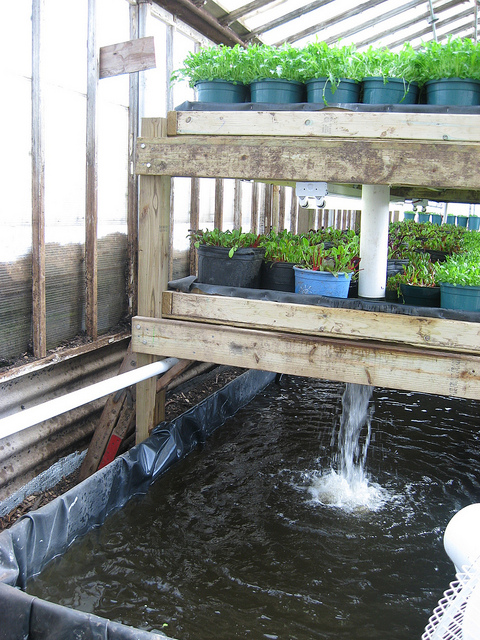
Aquaponics System permission Kate Field (https://creativecommons.org/licenses/by-sa/2.0/)
In my opinion, the aquaponics community is mostly an individual and educational community with strong commitments to sustainability issues. They are often building on a small-scale and don’t necessarily come from a strong technical background and scientific background. They have been doing a great job advocating aquaponics and raising awareness of water and food sustainability issues.
Now, aquaponics needs more thorough scientific and technical analysis to ride this advocacy and make a solid, objective, scientifically-based case to key external stakeholders such as investors and policy makers/regulators. Just to be clear, I personally think that aquaponics has great potential as a source of sustainable food production, but a more comprehensive set of studies need to be made of its risks and capabilities.
Many people who have researched aquaponics or tried building there own system can related to the frustration of looking for objective, verified third-party for aquaponics information. There isn’t really an organization that authoritatively provides best practices, technical data or economic information. There is not a community of peer-reviewed journals.
That’s why I not only hope to see more of this level of analysis in the future, but also organization and distribution networks that can effectively provide it.
Now I do have some criticisms of this paper. Though to be fair, not really criticism, just pointing out limitations. I think it was a fair assessment (from my non-guru level of expertise) under the scope that was set, comparing CURRENT aquaponics capabilities against CURRENT markets and conditions.
And that’s the scope the client probably wanted.
However, the immediate short-term scope is not holistic enough to judge aquaponics as a whole and answer the question of whether it should be pursued large-scale in the future. As we say in Canada, you don’t go to where the hockey puck is now, you go to where the hockey puck is going to be.
And in the case of society and food, the puck is going to be in a far different place. It’s going to be in a world of increased soil erosion, water scarcity and less argiculture-friendly weather, for instance.
This analysis excludes a holistic analysis such as externalized costs of conventional agriculture (e.g. soil erosion, unsustainable use of water) and changes in the future (e.g. improvement in aquaponics capabilities, climate change, increased water scarcity).
In a world with increased water-scarcity, is aquaponics more economically-feasible? Probably.
When soil erosion and water costs become internalized for conventional agriculture will it be as competitive? Probably not.
That’s why we need more holistic analysis – much more complex, but needed.
 Douglas Thoms