Want to keep up-to-date with my blog? Subscribe here!

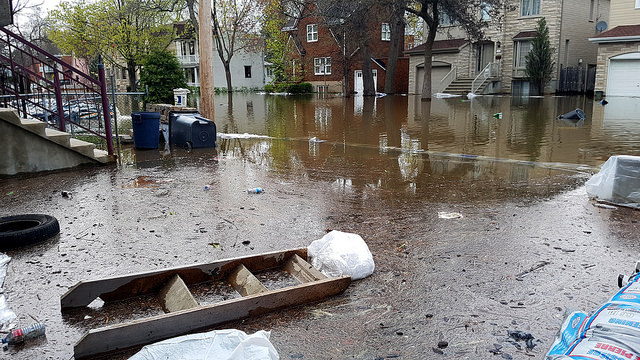
(Courtesy of Ryan McGilchrist, Attribution-ShareAlike 4.0 International (CC BY-SA 4.0) https://creativecommons.org/licenses/by-sa/4.0/legalcode)
Flooding will be one of the most common climate change risks for real estate owners. However, many owners are unaware of the risk as people associate flooding mainly with coastal areas. Places like Florida, Houston.
However, flooding can also happen in inland places like Ontario, Canada (for instance Toronto and Muskoka).
Last year these places both experienced flooding and damage, as well as many parts of Canada. But these places are not near a sea or ocean, so what exactly happened?
In the case of Toronto, it’s on a big body of water – Lake Ontario. The unusually early and fast snow melt and high amount of rain led to record high-water levels on Lake Ontario that flooded 13 buildings. It was much worse around other parts of Lake Ontario and St. Lawrence river with severe flooding in Ottawa and Montreal areas.
(Courtesy of Fred: https://creativecommons.org/licenses/by-sa/2.0/legalcode Attribution-ShareAlike 2.0 Generic (CC BY-SA 2.0))
There is also a risk of flooding away from bodies of water, especially in urban environments. The lack of permeable landscape means that the water cannot be absorbed by the land and instead goes into the sewer system. It can overpower the sewer system leading to floor drains backing up and streets flooding.
In short, in a country like Canada, regardless of where you are, there is a potential for real estate to flood, even in places where traditionally flooding is not an issue (like Toronto).
And unfortunately, flooding will become an even more significant issue for real estate considering that climate change is making the weather more extreme and erratic.
University of Ottawa climate scientist Paul Beckwith explains
“[w]hat we can see is that the jet streams are behaving differently. They’re much slower, wavier, and storms are therefore moving slower. So when they’re carrying water, they’re hovering over an area longer than they would be normally, so they’re depositing more water.”
So as a current/prospective property owner what can you do?
Check the elevation of the property.
Beckwith, during his CBC Radio’s Ottawa Morning interview, argued that elevation will probably become a key indicator of property value in the near future. “I think in the very near future, the elevation of a house will be on the MLS [real estate] system,” he said. “So when you buy a house, you’ll know the local elevation. So houses that are on higher ground will command higher prices. Houses on lower ground — if you flood now, you’re going to flood in the future.”
And that’s good news, because checking the elevation of a property is something you can easily do online.
Will it give you an exact idea of the risk?
No, because other weather and geographic factors such as bedrock type and soil composition influence flooding issues. However, it can give you an approximate idea and red-flag a property that may need further investigation.
I looked up a topographic map online.
First, I compared my region (around Toronto) to other regions in North American. Toronto has higher elevation than other regions such as Montreal or the East Coast of the United States. This already allows me to gauge a rough idea of the risk – Toronto area (GTA) will probably have less flooding issues than Montreal or the US East coast.

Next I look into the actual region. I see that the area that I live in has decent elevation relative to the shores around Lake Ontario.
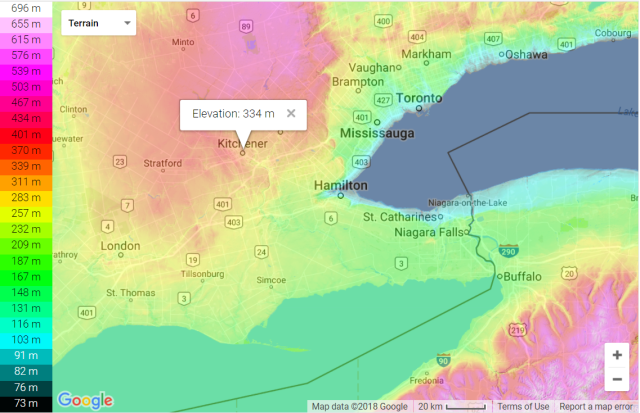
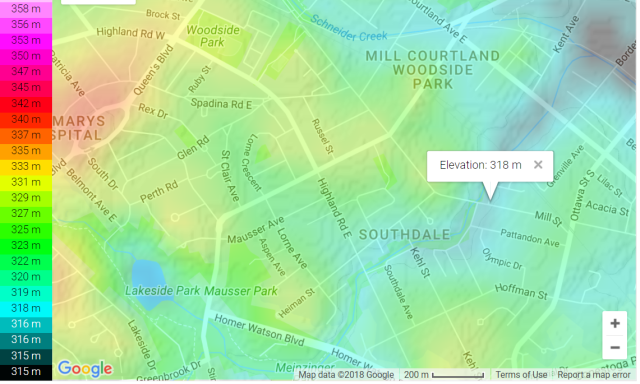
Finally, I can look at the topography of my neighbourhood. It looks like, unsurprisingly, the properties near local bodies of water, creeks and canals are at higher risk of floods. There is probably a chance that these areas would flood sooner when impacted by mass precipitation.
Finally, the age of the building can also indicate the likelihood of waterproofing. Nowadays in Canada, sump pumps and waterproofing membranes are standard but older homes may not have them. The chances are the older the home, the less waterproofing there is.
Trying to track all the possible risks and impacts of climate change can seem overwhelming, but by doing some simple research, like checking elevation, you can cut down the uncertainty and get a better sense of the risks climate change poses to a property.
Previous: How Climate-Proof is your Local Economy?
 Douglas Thoms
2 thoughts on “Is your Property’s Elevation Flood-Resilient?”